
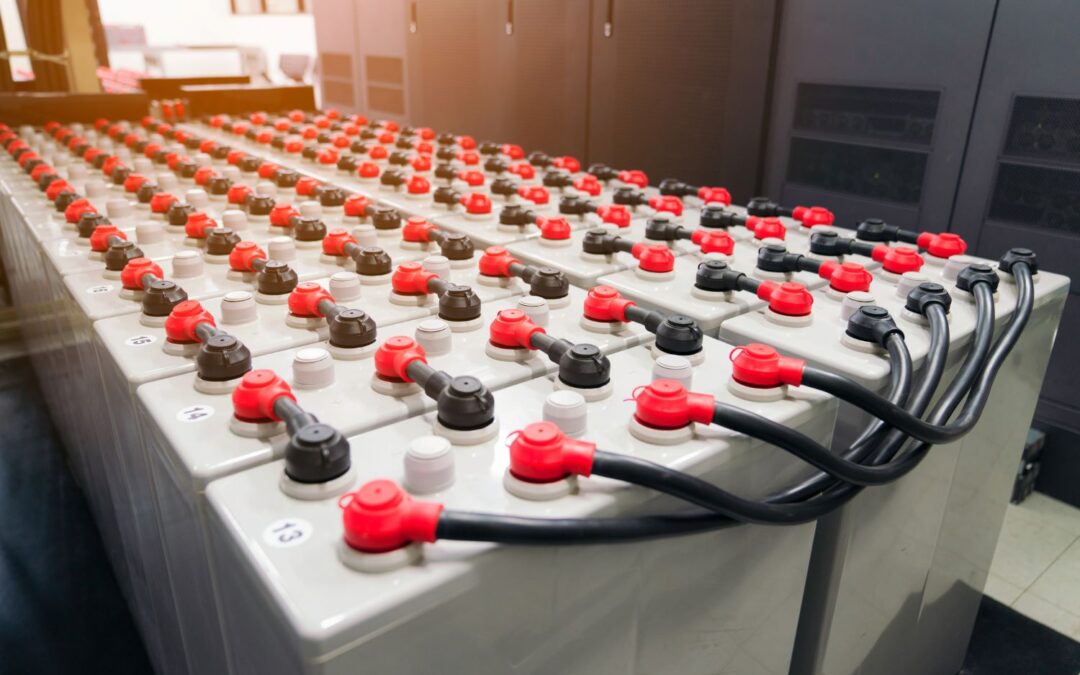
With emerging lithium and sodium competition, unlocking the electrolyte could be lead-acid’s key advantage.
If you’re a lead-acid provider, there are many reasons to be excited about the growing data center backup power market. Between favorable costs over lithium ion systems and infrastructure such as manufacturing already built, lead-acid is naturally poised to become a go-to technology for backup as data centers scale.
But even with the tailwinds, the competition is still real. Lithium-ion’s long cycle life, high energy density, and low maintenance presents a credible long-run TCO case. Meanwhile, earlier-stage sodium-ion promises similar gains at lower material cost, potentially without much of lithium’s supply chain and safety risks.
How can lead-acid manufacturers secure their position? One option is to expand capabilities into lithium-ion and sodium-ion directly – as companies like Clarios have done. But given the cost of necessary acquisitions, the difficulty of integrating unfamiliar technology, and the risk of cannibalizing existing business, many lead-acid firms are pursuing a second route: improving the technology they already have.
The good news is that achieving that competitive edge is within reach, with the help of an often-overlooked part of the aqueous battery: the electrolyte.
Why Lead-Acid’s Tech Path Lies In the Electrolyte
For lead-acid manufacturers competing for data center business, the goal is to extend cycle life, improve energy density, and reduce total cost of ownership. The electrolyte is an obvious path to all three. In aqueous systems, the electrolyte determines how much charge moves, how efficiently, and how consistently over time. Capacity, efficiency, and cycle life all flow from it. Electrolytes are especially promising routes to provide a competitive edge in two core areas: total cost of ownership, and power density.
- Lowering TCO Through Better Material Utilization
Electrolyte improvements directly improve how much lead is doing productive work. Hydrogen evolution, corrosion, and uneven ion transport all reduce active material utilization — and all are governed by the electrolyte environment. A better electrolyte means less lead needed for the same output, improving both material cost and TCO. - Slowing Aging Through Sulfation Control
Electrolyte chemistry sets the conditions under which lead sulfate reverses cleanly on recharge versus becoming permanently inert. Crystal nucleation and growth rate are functions of local ion concentration and pH — meaning a better electrolyte directly reduces sulfation accumulation, preserving power density and cycle life on the metrics data centers care about.
Given the above, the electrolyte seems like an obvious area for data center-bound lead-acid manufacturers to explore – and organic additives in particular are especially promising here. Across various types of aqueous systems, organic additives have proven highly effective at suppressing gassing, reducing corrosion, and extending cycle life — the same failure modes that limit lead-acid performance.
For instance, Octet’s organic electrolyte additives for zinc technologies have driven results including:
- 10% round-trip efficiency boost
- 2x cycle life
- 10–30% BOM cost reduction
These results are from zinc-based systems, which feature failure modes and electrolyte dynamics that are closely related to those in lead-acid. The results point to what targeted electrolyte chemistry may be able to deliver for lead-acid as well.
So far, though, the lead-acid industry hasn’t gravitated toward electrolyte answers on account of stability concerns. Those stability concerns make sense on paper – but they may also be a case of understandable hesitation standing in the way of growth.
Lead-Acid’s Surprising Electrolyte Stability
Given lead-acid’s harsh environment of concentrated sulfuric acid, high voltage, and wide temperature swings, the stability concerns make sense. In that setting, many organic molecules can be expected to degrade, oxidize, or react unpredictably during cycling.
But at the same time, stability issues have shown to be surmountable. In lab tests, Octet has already demonstrated stable additives in pH <1 and halide environments. The technical barrier is likely far lower than many in the industry assume – while the upsides have the potential to place lead-acid in the winner’s circle of data center backup growth.
For lead acid firms looking to unlock competitive battery performance, the electrolyte deserves serious attention. It offers a promising path to better material utilization, sulfation control, and a competitive edge in the data center backup race.
▶ To learn how electrolyte improvements may help your technology compete, talk to Octet.