
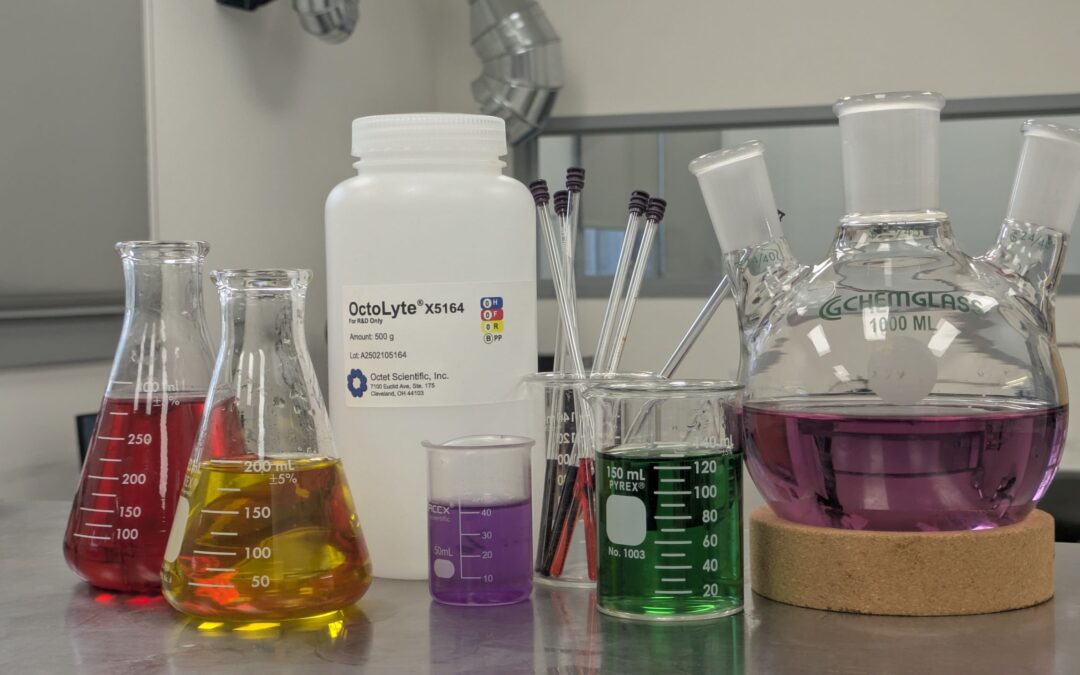
Read how Octet tested 30+ electrolyte additives and identified a formulation that could boost round-trip efficiency by 10% for a zinc-air battery developer.
“In zinc-air systems, hydrogen evolution quietly drains value with every cycle. But through targeted corrosion testing across multiple concentrations, we found an additive that meets the goal and stands to transform the economics of the whole system.”
— Onas Bolton, Founder & CEO, Octet Scientific
The Challenge: Solve the Self-Discharge Problem
The customer sought to improve overall round-trip efficiency, but faced a persistent obstacle: self-discharge caused by the hydrogen evolution reaction. This parasitic process was limiting the system’s commercial viability.
.
Octet’s Process: 30+ Additives, Multiple Concentrations
Octet tested over 30 individual additives, each evaluated at multiple concentrations to find the optimal chemistry and dosage.
Each candidate was assessed for:
- Corrosion inhibition efficiency
- Coulombic efficiency impact
- Charge voltage stability
.
Results: Exceeding Project Goals
Octet identified three strong candidates that all exceeded the project goal of 50% corrosion inhibition. Two of those candidates also showed significant potential to increase efficiency.
Performance at optimized concentrations:
| Control | 0.01% Octet Additive A | 0.01% Octet Additive B | 0.05% Octet Additive C | |
| Corrosion Inhibition Efficiency (GOAL: >50%) | 0% | +65% ✓ | +65% ✓ | +64% ✓ |
| Coulombic Efficiency (GOAL: Maintain) | 85% | 82% | 88% (+3%) | 92% (+7%) |
| Charge Voltage (GOAL: Maintain) | 1.462 | 1.456 ✓ | 1.458 ✓ | 1.462 ✓ |
.
Impact: $7.5M in Projected First-Year Savings
The customer is planning to incorporate Octet Additive C into their next battery installation.
They believe their round-trip efficiency could be improved by 10%, providing potential savings of $7.5M in their first commercial year.
.
Talk to Octet
Ready to unlock efficiency gains in your aqueous battery system?
Schedule your Octet consultation now.
